One sentence. Sixty-two years on, most people can finish it without being told where it comes from. In his 1961 inaugural address, John F. Kennedy used a technique called the balanced line — a sentence built in two mirroring halves — and the result has outlasted almost everything else spoken in that decade. This breakdown, taken from the Ummuted Greats series, walks through the six steps that make the structure work: how to build it, how to deliver it, and how to use it without wasting it.
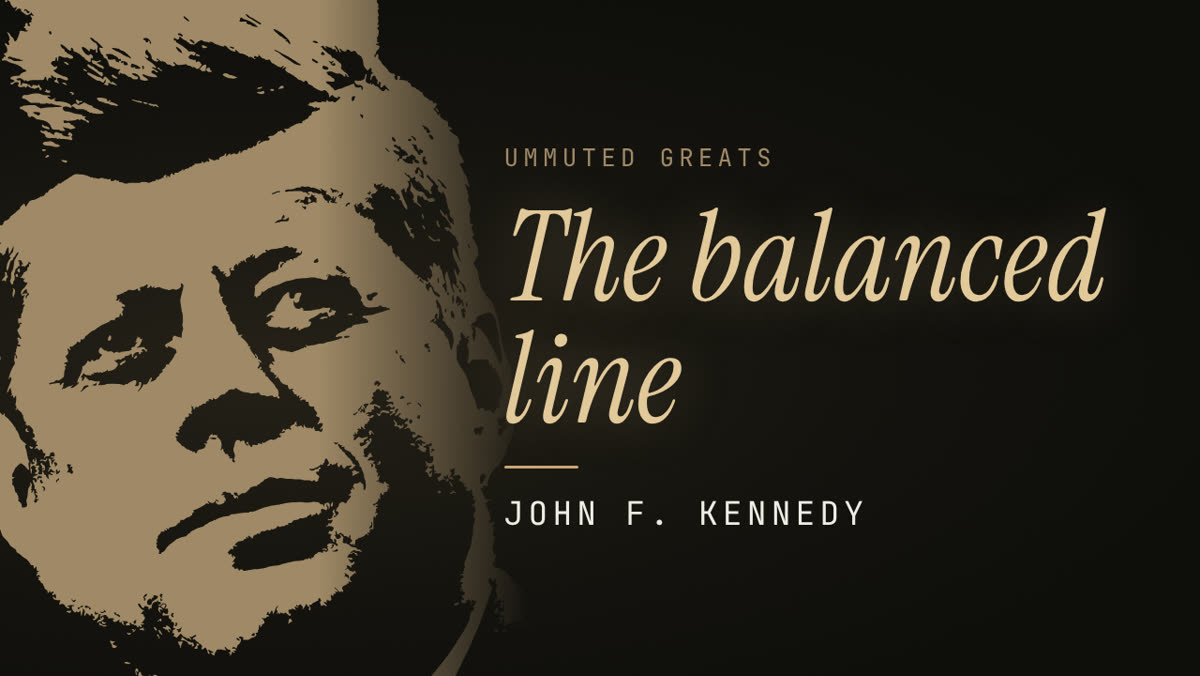
By the end, you will be able to take a sentence you already say and reshape it so that it lands with the same sense of finality.
Step 1: Build it in two halves
The balanced line begins as a structural decision, not a stylistic one. You split your sentence in two, and you make the second half mirror the first — same rough shape, inverted meaning. The moment the first half is out of your mouth, the room can feel that something is being held open. It waits.
Kennedy's first half: "Ask not what your country can do for you" — the pitch lifts slightly and leaves the thought unresolved. That openness is not an accident. It is an invitation. The audience leans in because the sentence has made a promise it has not yet kept.
This is the whole engine of the technique. Before you think about delivery, you have to build the architecture. Two halves. One promise, one answer.
Step 2: Lift the first, drop the second
Once the structure is in place, intonation carries it home. The first half rises — not into a question, but into an expectation. The second half falls, firmly and without apology.
Kennedy's second half: "ask what you can do for your country." — the voice comes down and the thought closes.
That fall matters more than people realise. A sentence that ends on a rising or level tone sounds like it is waiting for a response, or like the speaker is uncertain. The drop tells the room: this is the whole thought, it is complete, and I mean it. Without the fall, the most famous line in American political oratory would sound like a question nobody answered.
If you find your sentences trailing upward at the end — a habit that affects fluency and authority more than almost any other — the balanced line is a useful structure to practise, because the falling close is built into it by design.
Step 3: Stress only what swapped
Both halves of Kennedy's line share almost every word. You. Country. Can do. The architecture is the same. The only thing that changes is who owes what to whom. And those are the only words that earn any extra weight.
Compare it to this teaching sentence: "Not what they owe you, what you owe them." Four stresses, not nine. If you press every word equally, the mirror disappears — you get emphasis without contrast, which is no emphasis at all.
The discipline here is restraint. Find the two or three words that have genuinely traded places, mark those, and let the rest sit quietly underneath them. The contrast does its work precisely because everything around it is still.
Step 4: Hold the hinge
Between the two halves, there is a pause. Not a long one — a single, deliberate beat. But it is not optional.
The pause at the hinge is where the audience does the work. They have heard the first half, they have felt the shape, and now they are completing the pattern in their heads before you give them the answer. Take the pause away and the line becomes a long sentence. Keep it and the line becomes a structure — something the listener inhabits, not just receives.
This is the step that most people skip when they first try the technique. They build both halves correctly, they get the intonation right, and then they rush the hinge because silence feels like a gap to fill. It is not. It is the mechanism.
Step 5: Match the weight
Rhythm is what makes the second half feel like an answer rather than an afterthought. If the first half runs to twelve words and the second to four, the landing is lopsided — the sentence tips forward and never really closes.
Kennedy's original line is nine words, then eight. Near-identical. Consider this teaching example: "We asked for little, we were given less." Four words, then four. The equal weight means the second half arrives with the same authority as the first — it does not feel smaller, or rushed, or added on.
When you write or build a balanced line, count. Adjust. A syllable or two either way will not break it, but a gross imbalance will. The ear is measuring even when the audience does not know it is.
Step 6: Spend it once
A balanced line is a full stop for an entire argument. It is the moment when everything you have been building resolves into a single, closed thought. That is its value — and that value is not renewable within the space of a minute.
Use two balanced lines in quick succession and neither one is an ending any more. They cancel each other out. The first one promises arrival; the second one tells the audience the first was not quite it. You end up with rhythm where you should have had weight.
Find the one moment in your talk — the one claim, the one idea — that deserves to be sealed. That is where the balanced line lives. Everywhere else, let it be ordinary.
How to practise this
The exercise the video sets is simple: take a sentence you say often — something from a presentation, a pitch, a meeting — and rebuild it in two halves.
Lift the first half. Hold the hinge for one beat. Drop the second half. Then identify which one or two words actually changed between the halves, and give only those the extra stress.
Say it aloud. Record yourself if you can — hearing your own delivery back is where most of the learning happens. Listen for three things: does the first half feel open? Does the second half close? Did you hold the pause or rush it?
If the line still sounds like a question, the fall on the second half is not committed enough. If it sounds flat, you are stressing too many words and the contrast has nowhere to land. If the hinge feels awkward, you are probably not holding it long enough — the discomfort of silence in that beat is exactly right.
Practise it until the structure feels like a choice, not an effort.
Kennedy's inaugural address contains other techniques worth studying, but the balanced line is the one people carry with them for life. It works because it gives the audience a shape to follow, a moment of suspense, and then a clean resolution. It works because the intonation makes the grammar audible. And it works because he used it once, gave it room, and trusted it to be enough.
Balance is not decoration. It is how a sentence tells the room it has finished.